
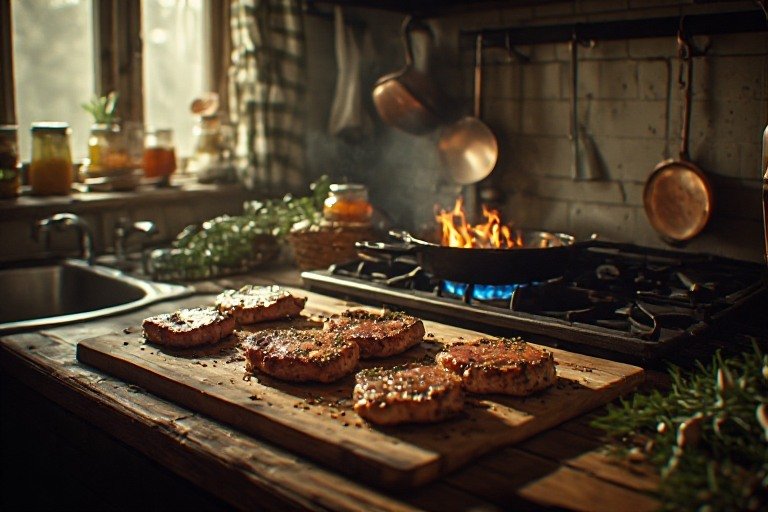
The Perfect Sear (Mastering Lean Proteins)
The Mindset Shift
Protein is vital for stabilizing blood sugar because it triggers fullness hormones, digests slowly, and doesn’t cause glucose spikes. However, many beginners routinely overcook lean proteins like chicken breast or pork loin, leaving them dry, chalky, and unappealing.
To fix the dry texture, people often resort to smothering their meat in sugary commercial barbecue sauces, ketchups, or sweet glazes. When you master the art of controlling pan heat and tracking internal temperature, your protein will turn out incredibly juicy and flavorful all on its own—no sugar required.
The Three Rules of a Professional Sear
To get a beautiful, golden-brown crust (which creates massive savory flavor through a chemical process called the Maillard reaction), you must follow three rules:
1. Moisture is the Enemy of a Sear: If meat goes into a pan wet, the heat has to boil away the surface water before it can brown the meat. This steams the protein, turning it gray and tough. Always pat your meat completely dry with paper towels right before cooking.
2. Respect the Pre-Heat: Never drop cold meat into a cold pan with cold oil. The meat will absorb the oil like a sponge and stick to the surface. Your pan must be hot before the food ever arrives.
3. Let it Release Naturally: If you try to flip a piece of chicken and it feels stuck to the pan, leave it alone. Meat naturally releases itself from the cooking surface once a proper golden crust has formed. If it’s sticking, it’s telling you it isn’t ready to flip yet.
Step-by-Step Technique: Managing Heat & Internal Temp
- Step 1: The Dry and Season Room-Temp Prep
- Take your lean protein (such as a boneless, skinless chicken breast or a pork chop) out of the refrigerator 15 minutes before cooking to take the chill off. Pat it firmly with a paper towel until it is completely bone-dry. Season both sides generously with salt, pepper, and garlic powder.
- Step 2: The Pan Setup
- Place a heavy skillet (cast iron or stainless steel works best) over medium-high heat. Let the dry pan heat up for 2 to 3 minutes. Add 1 tablespoon of a high-smoke-point oil, like avocado oil. Swirl the pan—if the oil is shimmering and moving fluidly like water, it is ready.
- Step 3: The Cook & The Flip
- Lay the protein into the pan away from you so oil doesn’t splash. You should hear an immediate, loud sizzle. Let it cook undisturbed for 4 to 5 minutes. Once a golden crust forms, it will easily release from the pan. Flip it over to cook the second side, then lower the heat slightly to medium.
- Step 4: The Digital Thermometer Check
- Stop guessing when meat is done by cutting it open and letting all the juices escape. Insert a digital meat thermometer into the thickest part of the protein:
- Chicken Breast: Remove from heat exactly at 165°F (74°C).
- Pork Chops / Steak: Remove from heat at 145°F (63°C). Let the meat rest on a cutting board for 5 minutes before slicing to allow the juices to redistribute throughout the protein.